
Chapter 1
Understanding Pain, Tendons and Healing
The Foundation of Successful Shockwave Therapy
When people develop long-lasting pain in a tendon, one of the first questions they ask is:
“Why isn’t it healing?”
It’s a sensible question.
Most people expect the body to repair itself after an injury. A cut heals, a bruise fades, and a broken bone gradually becomes strong again.
Unfortunately, tendons don’t always behave in the same way.
Persistent tendon pain can continue for months—or even years—not because the body has “given up”, but because tendon healing is a gradual, complex process influenced by many factors.
Understanding how tendons work and why pain sometimes persists helps explain where Extracorporeal Shockwave Therapy (ESWT) may fit within a modern rehabilitation programme.
What Is a Tendon?
A tendon is a strong band of connective tissue that joins a muscle to a bone.
When a muscle contracts, it pulls on the tendon, which transfers that force to the bone and produces movement.
Every time you:
- walk
- climb stairs
- lift shopping
- type on a keyboard
- throw a ball
- run
- jump
your tendons are working.
Without healthy tendons, even simple movements become difficult.
Why Are Tendons So Strong?
Healthy tendons are made primarily from Type I collagen.
Imagine thousands of microscopic ropes bundled together.
Each rope contains smaller fibres.
Those fibres contain even smaller strands.
This layered design allows tendons to be incredibly strong while remaining flexible enough to store and release energy.
For example:
When you run, your Achilles tendon behaves like a spring.
Rather than your calf muscles doing all the work, the tendon stores energy when your foot lands and releases it during push-off.
This energy-saving mechanism makes running remarkably efficient.
Tendons Are Living Tissue
Many people imagine tendons as inactive cords.
They aren’t.
Although tendons receive less blood supply than muscles, they remain living tissue throughout life.
They constantly respond to:
- exercise
- inactivity
- ageing
- illness
- nutrition
- hormones
- loading
This means tendons continually adapt.
Healthy loading encourages tendons to become stronger.
Too little loading can reduce their capacity.
Too much loading, especially when increased too quickly, may exceed what the tendon can currently tolerate.
Why Do Tendons Become Painful?
Modern physiotherapy no longer views persistent tendon pain simply as “inflammation.”
In many long-standing cases, the tendon has undergone changes in its structure and function rather than remaining inflamed.
Instead, clinicians often think about:
- reduced load tolerance
- changes within the tendon tissue
- altered pain sensitivity
- reduced ability to cope with repeated stress
These factors can contribute to ongoing symptoms even when there is no new injury.
Understanding Tendinopathy
The term tendinopathy describes persistent tendon pain and dysfunction.
It is commonly used for conditions such as:
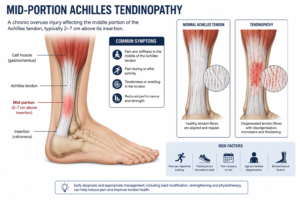
- Achilles tendinopathy
- Tennis elbow
- Golfer’s elbow
- Patellar tendinopathy
- Gluteal tendinopathy
- Rotator cuff tendinopathy
Typical symptoms include:
- pain during activity
- stiffness after rest
- discomfort first thing in the morning
- reduced strength
- tenderness when pressing on the tendon
- pain after exercise
Many people notice they can “warm into” activity before symptoms increase again later in the day.
Tendons Prefer Gradual Loading
One of the most important discoveries in tendon rehabilitation is that appropriate loading is usually beneficial.
Years ago, patients were often advised to rest painful tendons completely.
We now know prolonged rest can reduce tendon capacity.
Instead, many rehabilitation programmes use carefully progressed exercise to encourage the tendon to adapt over time.
Examples include:
- heavy slow resistance training
- eccentric loading
- isometric exercises
- functional strengthening
- sport-specific rehabilitation
The exact programme depends on the tendon involved, your symptoms, and your goals.
Why Healing Sometimes Takes So Long
Several factors influence recovery.
These include:
Age
As we age, tendons naturally become less adaptable and may take longer to respond to rehabilitation.
Training Errors
Increasing running distance, lifting heavier weights or returning to sport too quickly can overload a tendon before it has adapted.
Recovery
Sleep, nutrition and appropriate recovery all play a role in tissue adaptation.
Medical Conditions
Some health conditions and medications can affect tendon health and healing.
Biomechanics
Movement patterns, muscle strength and flexibility may influence how force is distributed through a tendon.
Pain Does Not Always Equal Damage
This is one of the most important concepts for patients to understand.
Pain is a protective signal produced by the nervous system.
While pain can indicate tissue injury, the relationship between pain and tissue damage is not always straightforward.
Some people have significant structural changes on imaging with little or no pain.
Others experience considerable pain despite only minor structural findings.
For this reason, clinicians consider:
- your symptoms
- physical examination
- functional ability
- goals
- overall health
rather than relying on scans alone.
Where Does Shockwave Therapy Fit?
Shockwave Therapy is not a magic cure.
It is not a replacement for exercise.
It does not repair every painful tendon.
Instead, ESWT is one treatment option that may be considered for some persistent tendon conditions, particularly when symptoms have not improved sufficiently with appropriate rehabilitation alone.
Current clinical practice typically combines ESWT with:
- education
- progressive loading exercises
- activity modification where appropriate
- strength training
- advice on recovery
- review of progress over time
This combined approach aims to improve function and help patients return to the activities that matter to them.
Setting Realistic Expectations
Most people hope for a quick fix.
Unfortunately, tendon rehabilitation rarely works that way.
Successful treatment usually depends on:
- an accurate diagnosis
- an individual rehabilitation programme
- consistency with exercises
- gradual progression
- patience
ESWT may form one part of that process, but it works best when integrated into a comprehensive rehabilitation plan rather than used in isolation.
Key Takeaways
- Tendons connect muscles to bones and transmit force for movement.
- Tendons adapt throughout life in response to loading.
- Persistent tendon pain is often referred to as tendinopathy.
- Modern rehabilitation focuses on improving tendon capacity through appropriately prescribed exercise.
- Pain does not always reflect the amount of tissue damage.
- ESWT may be considered for some persistent tendon conditions as part of a broader rehabilitation programme.
- Recovery is usually gradual, and a combination of education, exercise and appropriate treatment offers the best opportunity for improvement.
Our Location