
Twisted your ankle? Don't just wait for it to get better!
22 October 2026
Written by Faris Mumnoon, BSc Hons, MCSP · Physiotherapist
Whether you've rolled your ankle playing football, landed awkwardly during a workout, missed a step on the stairs or injured it during a walk, ankle injuries can affect much more than just your ability to walk.
So, if you came to see me with an ankle injury, how would I assess it, and what would your rehabilitation look like?
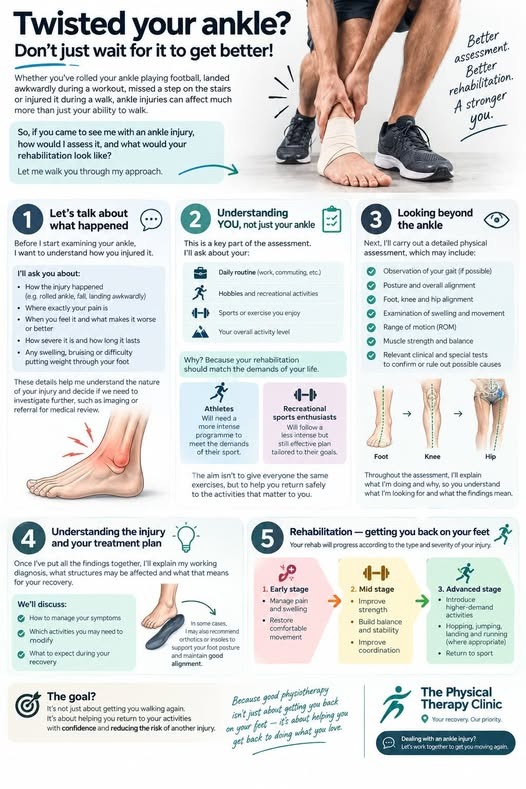
1. First, let's talk about what happened
Before I start examining your ankle, I want to understand how you injured it.
Did you roll your ankle inwards? Land awkwardly after a jump? Fall down the stairs? Or did the pain develop gradually?
I'll then ask you about your symptoms:
- Where exactly is your pain?
- When do you feel it, and what makes it better or worse?
- How severe is it, and how long does it last?
- Have you noticed any swelling, bruising or difficulty putting weight through your foot?
I'll also check for any signs that you might need further medical assessment or imaging before we proceed with rehabilitation.
These details help me understand the nature of your injury and decide what we need to investigate further.
2. Understanding you, not just your ankle
This is a part of the assessment that I think is really important.
I'll ask about your usual daily routine, your job, your hobbies, your activity levels and the sports or exercises you enjoy.
Why? Because your rehabilitation should match the demands of your life.
- If you're an athlete who needs to sprint, jump, change direction and compete, your rehabilitation will need to progressively prepare you for those demands.
- If you enjoy recreational sport, go to the gym or simply want to walk comfortably without pain, your programme will be tailored to those goals instead.
The aim isn't to give everyone the same exercises. It's to help you return safely to the activities that matter to you.
3. Looking beyond the ankle
Once I've taken your history, I'll move on to the physical assessment.
Where appropriate and safe, I'll observe your walking pattern and look at your foot posture, ankle movement, swelling and overall lower-limb alignment, including your knee and hip.
I'll assess your range of motion, strength, balance and stability. Depending on your symptoms and the mechanism of injury, I'll also perform relevant clinical and special tests to investigate the structures involved and help confirm or rule out possible causes.
Throughout the assessment, I'll explain what I'm doing and why, so you understand what I'm looking for and what the findings mean.
4. Understanding the injury and your treatment plan
Once I've put the findings together, I'll explain my working diagnosis, what structures may be affected and what that means for your recovery.
We'll discuss how to manage your symptoms, which activities you may need to modify and what to expect as you recover.
If your foot posture or alignment is relevant to your symptoms, we may also discuss whether appropriate insoles or orthotics could help support your foot and improve comfort during activity. These aren't necessary for everyone, so the decision would depend on your individual assessment.
5. Rehabilitation – getting you back on your feet
Your rehabilitation will progress according to the type and severity of your injury and how your ankle responds.
- Early stage. Initially, the focus may be on managing pain and swelling, restoring comfortable movement and helping you walk more normally.
- Mid stage. As you improve, we'll work on rebuilding your ankle strength, balance, coordination and stability.
- Advanced stage. And if you play sports, we won't stop there! We'll gradually introduce more demanding activities such as hopping, jumping, landing, running and changing direction, where appropriate, to prepare your ankle for the demands of your sport.
The goal
The goal is not just to get you walking again. It's to help you return to your activities with confidence and reduce the risk of another injury.
Remember… Two people can injure their ankle in exactly the same way but need very different rehabilitation programmes.
That's why I believe in understanding the person behind the injury, tailoring treatment to their goals and progressing rehabilitation according to their recovery.